

Myopia Management in League City, TX
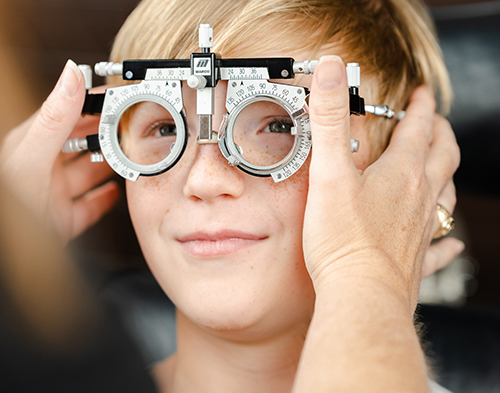
Helping Protect Your Child's Vision—Now and for the Future
If your child's glasses prescription seems to get stronger every year, you may have wondered whether there is anything you can do besides keep updating their glasses.
Today, the answer is yes.
Myopia, or nearsightedness, often begins during childhood and can continue to progress as the eyes grow. Traditional glasses and contact lenses help your child see clearly, but myopia management goes a step further: our goal is to slow the progression of myopia and reduce how nearsighted your child ultimately becomes.
At Restore Vision Center, we take a personalized approach to myopia management. Our doctors evaluate your child's vision, eye health, prescription history, lifestyle, and individual needs before helping your family decide which treatment approach makes the most sense.
Because managing myopia isn't just about helping your child see the board at school today. It's about protecting their vision for the years ahead.
What Is Myopia?
Myopia causes distant objects to appear blurry while objects up close remain clearer. It commonly begins during the school years and may continue progressing throughout childhood and adolescence. You may notice your child:
Squinting to see things far away
Moving closer to the television or screens
Having difficulty seeing the board at school
Struggling to see during sports or other distance activities
Complaining that their glasses no longer seem strong enough
Needing a stronger prescription at repeated eye exams
But children don't always realize their vision is blurry. Sometimes the first sign of myopia is discovered during a comprehensive eye exam.
Why Do We Want to Slow Myopia?
Clear vision is only part of the story.
Myopia generally develops as the eye grows too long from front to back. As myopia increases, so does a person's lifetime risk for certain eye diseases, including retinal detachment, myopic maculopathy, glaucoma, and cataracts.
That's why our goal isn't simply to prescribe stronger glasses every year.
When appropriate, we want to slow the progression of myopia while your child's eyes are still growing. Even reducing the amount of myopia a child ultimately develops can have meaningful benefits for their long-term eye health.
This shift—from simply correcting myopia to actively managing it—is one of the most important changes in children's eye care.
Myopia Management at Restore Vision Center
There isn't one "best" treatment for every child.
A treatment that's perfect for a 9-year-old athlete may not be the best choice for another child with a different prescription, lifestyle, comfort level, or family routine.
That's why we start by looking at the whole child.
During your child's evaluation, we'll consider factors such as:
Their current prescription
How quickly their myopia has been progressing
Their age and eye health
Contact lens readiness
School, sports, and other activities
Family history of myopia
Your family's preferences and ability to manage treatment at home
Then we'll explain the options, answer your questions, and help you decide what makes sense for your child and your family.
Myopia Management Options
Depending on your child's needs, we may recommend one treatment or a combination of approaches.
Myopia Control Spectacle Lenses
For children who prefer glasses, specialized myopia control lenses provide clear vision while incorporating advanced optical technology designed to slow myopia progression. Essilor Stellest® lenses are one of the options we offer when appropriate.
This can be a great choice for families looking for myopia management without contact lenses.
Orthokeratology (Ortho-K)
Ortho-K uses specially designed rigid contact lenses worn while your child sleeps. Overnight, they gently reshape the front surface of the eye so your child can remove the lenses in the morning and see clearly throughout the day without glasses or contacts.
We offer customized Ortho-K options, including ACUVUE® Abiliti™ Overnight Therapeutic Lenses, when appropriate for the child.
In addition to providing daytime freedom from corrective lenses, Ortho-K is an established approach for slowing myopia progression and can be especially appealing for active children.
Multifocal Soft Contact Lenses
Specialized soft contact lenses provide clear vision while also creating an optical effect designed to help slow the eye growth associated with myopia. Options include MiSight® 1 day contact lenses, which are specifically designed for myopia control in children.
For children who are ready for contact lenses, this can provide both myopia management and freedom from glasses during the day.
Low-Dose Atropine
Low-dose atropine eye drops may also be used to help slow myopia progression.
Depending on your child's individual situation, atropine may be recommended on its own or in combination with another myopia management treatment.
Myopia Management Isn't "Set It and Forget It"
Starting treatment is only the beginning.
Children's eyes are still developing, so regular monitoring is an important part of successful myopia management. We'll follow your child's progress over time to determine how well their treatment is working and whether adjustments are needed.
And as your child grows, their treatment plan can grow with them.
Our goal is not simply to hand you a product or prescription. It's to partner with your family throughout the years when your child's vision is changing most.
When Should My Child Be Evaluated?
You don't need to wait until your child's prescription becomes "really bad" to ask about myopia management.
In fact, earlier intervention can give us more opportunity to influence how myopia progresses during the years when the eyes are growing.
If your child:
Has already been diagnosed with myopia
Has needed repeated increases in their prescription
Has parents who are significantly nearsighted
Is beginning to show signs of distance blur
Or you've simply been told, "Their prescription got stronger again"
…it may be a good time to talk about whether myopia management is appropriate.
More Than a Stronger Pair of Glasses
As parents, we make a lot of decisions today with our children's future in mind. We believe their vision deserves the same approach.
At Restore Vision Center, we'll help you understand what's happening with your child's eyes, what options are available, and what we can do to help protect their vision as they grow.
That's part of what Restoring Sight, Giving Light means to us—not only helping your child see clearly today, but caring for the eyes they'll depend on for a lifetime.
Schedule a Myopia Management Evaluation in League City
If your child is nearsighted—or their prescription seems to be getting stronger year after year—we'd love to talk with you about their options.
Schedule a comprehensive eye exam or myopia management evaluation at Restore Vision Center in League City, TX.
Restore Vision Center
3510 W Main St
League City, TX 77573
(281) 724-3040
Hours of Operation
- Monday 9:00am - 5:30pm
- Tuesday 9:00am - 7:00pm
- Wednesday 9:00am - 5:30pm
- Thursday 9:00am - 5:30pm
- Friday 9:00am - 3:00pm
- Saturday Closed
- Sunday Closed
© 2026 Restore Vision Center. All rights Reserved. Accessibility Statement - Privacy Policy - Sitemap
Powered by:
